

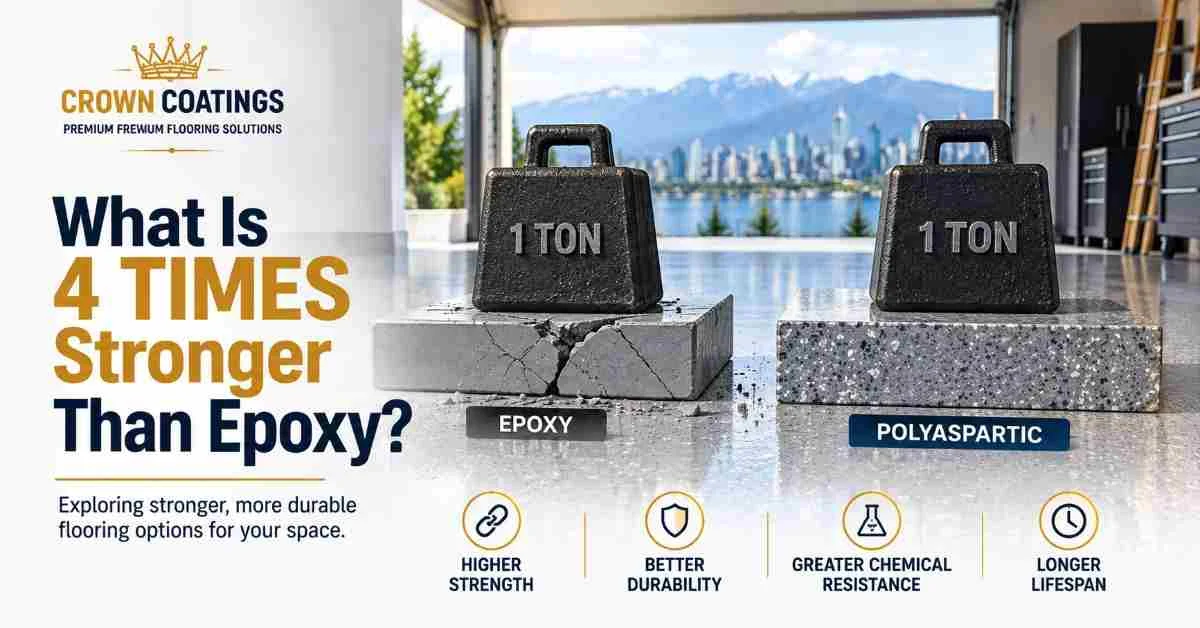
If you have been researching garage floor coatings, you have probably seen the phrase “4 times stronger than epoxy.” But what coating is actually 4 times stronger than epoxy?
The answer is generally polyaspartic or polyurea-based floor coating systems.
Polyaspartic coatings have become a popular alternative to traditional epoxy because they offer excellent abrasion resistance, UV stability, flexibility, chemical resistance and significantly faster curing. They are particularly well suited to garages, workshops, commercial spaces and other high-traffic concrete floors.
However, there is an important distinction: “4 times stronger” does not necessarily mean that a polyaspartic coating is four times stronger in every possible mechanical test. The exact comparison depends on the product, formulation and performance measurement being used.
So, what makes polyaspartic flooring such a strong alternative to epoxy?
Quick Answer: What Is 4 Times Stronger Than Epoxy?
Polyaspartic floor coatings are commonly marketed as being up to four times stronger or more abrasion-resistant than traditional epoxy systems, depending on the specific product and test being compared.
Polyaspartic is a modified polyurea coating designed to provide a tough, durable surface over properly prepared concrete. Compared with conventional epoxy, it typically offers:
- Excellent abrasion and wear resistance
- Superior UV stability
- Faster curing
- Greater flexibility
- Strong chemical resistance
- Excellent resistance to vehicle and foot traffic
- A lower risk of yellowing from sunlight
- Attractive decorative finishes, including flake systems
For homeowners looking for a premium garage floor coating, these characteristics make polyaspartic an increasingly popular choice.
What Is Polyaspartic Flooring?
Polyaspartic is a type of high-performance coating based on polyurea chemistry. It is formulated to cure quickly while providing a durable protective surface for concrete.
Unlike traditional epoxy, which cures into a relatively rigid coating, polyaspartic systems can provide greater flexibility and resistance to environmental changes.
Crown Coatings uses epoxy and polyaspartic systems for residential, commercial and industrial flooring projects throughout Vancouver and the Lower Mainland.
Polyaspartic flooring can be used for:
- Residential garages
- Workshops
- Commercial floors
- Warehouses
- Retail spaces
- Showrooms
- Industrial facilities
- Patios and other suitable exterior applications
The final performance depends on the complete coating system, concrete condition, surface preparation and installation process.
Why Is Polyaspartic Considered Stronger Than Epoxy?
The biggest advantage of polyaspartic isn’t simply one number called “strength.”
Floor coatings have to withstand several different types of stress, including abrasion, impact, chemicals, UV exposure, temperature changes and repeated vehicle traffic.
Polyaspartic systems are engineered to perform particularly well in many of these conditions.
1. High Abrasion Resistance
Garage floors experience constant wear.
Vehicle tires, foot traffic, dropped tools, equipment and dirt can gradually wear down an inferior coating.
Polyaspartic coatings are known for high abrasion resistance, making them suitable for areas where the floor receives frequent traffic.
Some manufacturers and installers describe particular polyaspartic products as offering approximately four times the abrasion or wear performance of standard epoxy under specified testing conditions.
The important point is that the exact “4×” figure depends on the products and testing methodology being compared.
2. Excellent UV Resistance
UV exposure is one area where polyaspartic has a significant advantage over many conventional epoxy systems.
Prolonged sunlight can cause some epoxy coatings to yellow or discolour. Polyaspartic coatings are generally formulated with strong UV stability, helping the floor maintain its colour and appearance over time.
This is especially useful for garages with open doors, sun exposure, patios and other areas where UV light reaches the coating.
Crown Coatings’ comparison information identifies polyaspartic as UV resistant, while conventional epoxy can yellow under UV exposure.
3. Faster Curing
Another major advantage is curing speed.
Depending on the specific formulation, temperature and installation system, polyaspartic coatings can cure much faster than traditional epoxy.
Crown Coatings’ current comparison guide lists typical walkable curing times of approximately 2–6 hours for polyaspartic, compared with 24–72 hours for epoxy, although actual project timelines vary.
Faster curing means less downtime for homeowners and businesses.
For a garage, this can mean getting your space back into use much sooner.
For a commercial facility, reducing downtime can be even more valuable.
Polyaspartic vs. Epoxy: What’s the Difference?
Both epoxy and polyaspartic are excellent concrete coating technologies, but they have different performance characteristics.
| Feature | Epoxy | Polyaspartic |
|---|---|---|
| Durability | Excellent | Excellent |
| Abrasion resistance | High | Very high |
| UV stability | Moderate to good, depending on formulation | Excellent |
| Flexibility | Generally more rigid | More flexible |
| Cure time | Typically longer | Typically faster |
| Chemical resistance | Excellent | Excellent |
| Decorative finishes | Yes | Yes |
| High-traffic applications | Yes | Excellent |
| Outdoor/UV exposure | Product dependent | Generally better suited |
| Installation downtime | Longer | Shorter |
This doesn’t mean epoxy is a poor flooring material.
In fact, epoxy remains an excellent choice for many interior applications, particularly when cost, chemical resistance and a thicker coating system are important considerations.
The right choice depends on the environment and the goals of the project.
Is Polyaspartic Better Than Epoxy for a Garage Floor?
For many homeowners, yes—especially when durability, UV resistance and fast installation are priorities.
A garage floor has to withstand much more than normal foot traffic.
It may be exposed to:
- Vehicle tires
- Hot tires
- Oil and automotive fluids
- Road salt
- Water and moisture
- Dirt and sand
- Dropped tools
- Heavy storage
- Temperature fluctuations
Polyaspartic coatings are well suited to these demanding conditions.
Crown Coatings’ own garage-flooring content highlights polyaspartic’s fast curing, UV performance and durability as key advantages for residential garages.
Does Polyaspartic Prevent Cracking and Peeling?
A coating cannot prevent structural movement or eliminate cracks in the underlying concrete.
However, the flexibility of polyaspartic systems can help them accommodate some movement better than a more rigid coating.
That is one reason proper concrete preparation is so important.
Before applying any professional floor coating, the concrete should be evaluated and appropriately prepared. Depending on the floor, preparation can include:
- Cleaning and degreasing
- Diamond grinding or other mechanical preparation
- Crack repair
- Joint assessment
- Moisture evaluation
- Primer or base-coat application
- Decorative flake or aggregate application
- Polyaspartic protective topcoat
Proper preparation is essential because even a premium coating cannot compensate for poorly prepared concrete. Crown Coatings’ installation guidance similarly emphasizes grinding or shot blasting, crack repair and moisture testing as important preparation steps.
Is “4 Times Stronger Than Epoxy” Literally True?
This is where homeowners should be careful. There is no single universal strength measurement for floor coatings.
Strength can refer to different properties, including:
- Tensile strength
- Compressive strength
- Flexural strength
- Adhesion
- Impact resistance
- Hardness
- Abrasion resistance
- Chemical resistance
Therefore, saying that one coating is “4 times stronger than epoxy” without identifying the product and test can be misleading. For example, a manufacturer may compare abrasion resistance between a particular polyaspartic product and a particular epoxy product and report a four-times improvement.
That does not necessarily mean the polyaspartic is four times stronger in tensile strength, compressive strength or every other category.
The best approach is to look at the technical data for the specific coating system being installed.
Why Choose Polyaspartic for a Garage?
For homeowners investing in a garage floor, polyaspartic offers several practical advantages.
Better UV Performance
If sunlight enters your garage regularly, UV stability can help maintain the floor’s appearance.
Faster Installation
Fast-curing materials can significantly reduce the time your garage is unavailable.
High Wear Resistance
A quality polyaspartic system can withstand substantial daily traffic and abrasion.
Chemical Resistance
Garage floors regularly encounter automotive fluids, oils and other contaminants. Polyaspartic systems can provide strong chemical resistance when properly specified.
Easy Maintenance
A seamless coated floor is generally much easier to clean than bare concrete.
Dirt, dust and spills can be removed without dealing with porous, unfinished concrete.
Premium Appearance
Polyaspartic systems can be combined with decorative vinyl flakes, quartz and other aggregates to create a customized garage floor.
Crown Coatings offers decorative flake flooring alongside its epoxy and polyaspartic solutions throughout the Lower Mainland.
Polyaspartic vs. Epoxy: Which One Should You Choose?
There isn’t a universal winner for every project.
Choose Polyaspartic If You Prioritize:
- Maximum abrasion resistance
- UV stability
- Fast installation
- Reduced downtime
- High-traffic performance
- A premium garage floor
- Long-term appearance
- Residential or commercial applications exposed to sunlight
Choose Epoxy If You Prioritize:
- A cost-conscious coating solution
- Strong chemical resistance
- A proven concrete coating technology
- Interior applications with limited UV exposure
- A thicker coating system
- Decorative options at a potentially lower initial cost. Some systems can become walkable within a few hours, while complete return-to-service times depend on the complete coating system and manufacturer’s specifications. Crown Coatings’ comparison guide lists approximately 2–6 hours Lower Mainland, while avoiding an unsupported blanket claim that every polyaspartic product is literally four times stronger in every respect. That distinction is particularly important because “strength” can refer to several different
In many professional flooring systems, epoxy and polyaspartic can also be used together rather than treated as competing technologies.
For example, a system may use an epoxy base for adhesion and build thickness followed by a polyaspartic topcoat for UV stability, wear resistance and appearance.
The best system depends on the concrete, environment, traffic requirements and desired finish.
How Long Does Polyaspartic Flooring Last?
The lifespan of a polyaspartic floor depends on several factors, including:
- Concrete preparation
- Product quality
- Coating thickness
- Installation quality
- Traffic levels
- Chemical exposure
- UV exposure
- Maintenance
- Existing concrete condition
A professionally installed system with appropriate preparation and materials can provide many years of service, but no coating should be given an unrealistic lifespan guarantee without considering the specific environment.
This is another reason why choosing an experienced flooring contractor matters.
What Makes a Polyaspartic Floor Last Longer?
The coating material is only one part of the equation.
Surface preparation is critical.
A professional installation should begin with properly prepared concrete. Contaminants such as oil, grease, dirt and weak surface material can interfere with adhesion.
Mechanical preparation, such as diamond grinding, helps create an appropriate surface profile for the coating system.
Cracks and other concrete defects should also be evaluated and repaired before coating.
At Crown Coatings, our flooring services cover residential, commercial and industrial applications throughout Vancouver and the Lower Mainland, with systems selected according to the requirements of each project.
Frequently Asked Questions
What is 4 times stronger than epoxy?
Polyaspartic or polyurea-based floor coating systems are commonly described as being four times stronger or more abrasion-resistant than traditional epoxy, depending on the specific product and performance test. The “4×” figure should always be verified against the manufacturer’s technical data.
Is polyaspartic stronger than epoxy?
Polyaspartic can provide superior abrasion resistance, UV stability and flexibility compared with many conventional epoxy systems. However, “stronger” depends on the property being measured, so the specific product data should be reviewed before making a direct comparison.
Is polyaspartic better than epoxy for garage floors?
For many garages, polyaspartic is an excellent choice because of its UV stability, fast curing, durability and resistance to wear. Epoxy can still be a very good option where budget and specific performance requirements make it more suitable.
Does polyaspartic yellow?
Quality polyaspartic topcoats are generally highly UV stable and resist the yellowing associated with prolonged sunlight exposure in many conventional epoxy systems.
How quickly does polyaspartic flooring cure?
Cure times vary by product and conditions. Some systems can become walkable within a few hours, while complete return-to-service times depend on the complete coating system and manufacturer’s specifications. Crown Coatings’ comparison guide lists approximately 2–6 hours as a typical walkable timeframe for polyaspartic.
Is polyaspartic more expensive than epoxy?
Generally, yes. Polyaspartic systems often have a higher upfront cost than conventional epoxy. However, faster installation, reduced downtime, UV performance and long-term durability may make the additional investment worthwhile for certain projects.
Can polyaspartic be used outdoors?
Certain polyaspartic formulations are suitable for exterior applications because of their UV stability. However, the coating must be specifically selected for the environmental conditions and substrate, and the manufacturer’s application requirements should be followed.
Final Verdict: What Is 4 Times Stronger Than Epoxy?
If you are searching for a floor coating that is commonly marketed as 4 times stronger than epoxy, polyaspartic is the answer.
Its combination of abrasion resistance, UV stability, flexibility, chemical resistance and fast curing makes polyaspartic an attractive alternative to traditional epoxy—particularly for garages and high-traffic concrete floors.
But don’t choose a coating based on the phrase “4 times stronger” alone.
The specific product, test data, coating system and installation quality matter just as much as the material itself.
For Vancouver and Lower Mainland homeowners and businesses, Crown Coatings provides professional epoxy and polyaspartic flooring solutions designed around the requirements of each concrete floor.
Ready to upgrade your concrete floor? Contact Crown Coatings for a free estimate and find out which coating system is right for your project.


